
Fast Reliable Turnaround
Request Your Appraisal Today
Residential
2 Business Days
Commercial
7 Business Days
If you own or are considering buying a retail plaza, an office building, an industrial property, or a mixed use asset, one question eventually comes up for everyone. What is this property really worth in today’s market? The answer is rarely simple, especially in Toronto where each asset class behaves differently and responds to different pressures.
Property valuation is not about applying one formula across all real estate. Retail, office, industrial, and mixed use properties are valued through different lenses because buyers, tenants, and lenders look at them differently. Understanding how value is determined helps you make better decisions whether you are refinancing, selling, buying, planning long term, or resolving a legal or tax matter.
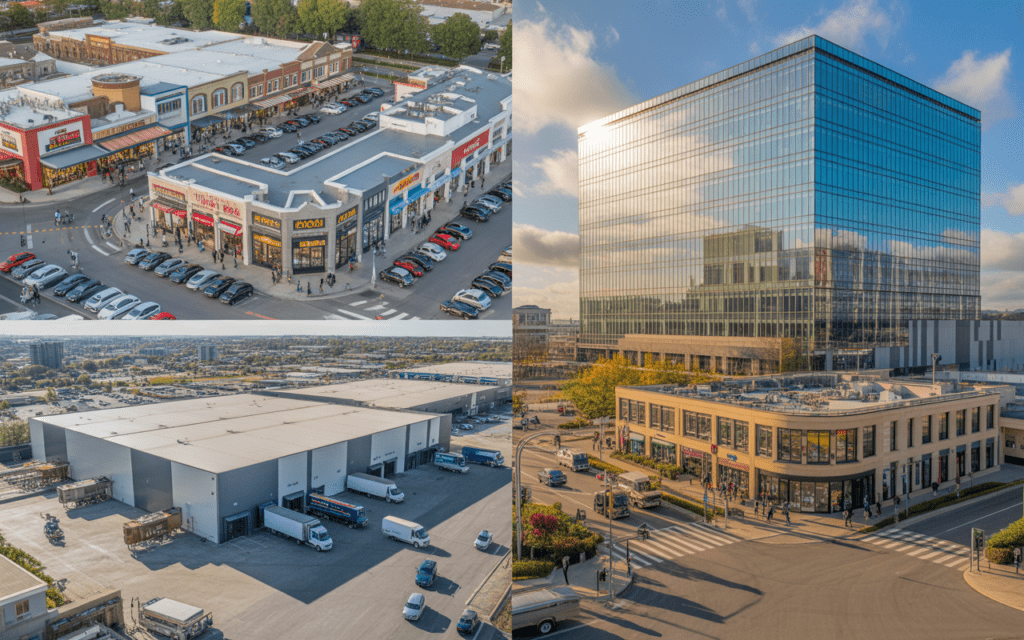
Commercial real estate value is shaped by how a property generates income, how stable that income is, and how easily the property can adapt to market changes. A retail unit on a busy Toronto street does not behave like an office floor downtown or a warehouse near the highway. Each serves a different purpose and attracts a different type of user.
As appraisers, our role is to understand how the market views each property type today, not how it performed in the past or how it might perform in a perfect future. This market grounded approach is what gives valuations credibility and usefulness.
Retail property value is closely tied to visibility, foot traffic, and tenant strength. In Toronto, location matters not just by address but by how people move through an area. A retail plaza near transit, residential density, or a daily needs corridor often performs very differently than one dependent on destination traffic.
Tenant mix plays a major role in value. Properties anchored by essential services like grocery, pharmacy, or medical users tend to show stronger stability. Short term or turnover heavy retail can increase risk, which affects value.
Appraisers also look at lease structures. Net leases, rent escalation clauses, and remaining lease terms all influence how investors price retail assets. The goal is to understand how predictable the income truly is.
Office valuation has changed significantly in recent years. Value now depends heavily on building quality, location, and adaptability. In Toronto, offices near transit with modern layouts and strong amenities tend to outperform older stock that no longer meets tenant expectations.
Occupancy levels are critical. A well leased building with strong tenants supports value more than a larger building with vacancy and short term leases. Appraisers assess not just current income, but the likelihood of sustaining it.
Office value is also influenced by conversion potential in some areas. Buildings that can adapt to alternative uses may carry different risk profiles, which must be carefully analyzed.
Industrial properties are often valued based on functionality and access. In the GTA, proximity to highways, ports, and logistics routes has a direct impact on value. Clear height, loading capabilities, power supply, and site circulation are not technical details. They are value drivers.
Industrial properties with modern specifications tend to attract stronger tenants and command better pricing. Older buildings may still hold value, but functional limitations can affect demand and future leasing potential.
For leased industrial assets, income stability and tenant credit quality are central to valuation. Investors want predictable returns, and appraisers reflect that expectation in their analysis.
Mixed use properties are among the most complex to value because they combine multiple asset types under one roof. Residential units, retail space, office components, and sometimes parking or storage all contribute differently to overall value.
Appraisers typically analyze each component separately before reconciling the property as a whole. Residential income may be stable while retail income fluctuates. Office components may carry different risk profiles.
Zoning and land use potential also play a larger role in mixed use valuation. In Toronto, redevelopment or intensification potential can influence value, but only when it is realistic and supported by market evidence.
Across all commercial property types, income analysis is a core valuation method. Appraisers review rents, expenses, vacancy trends, and market yields to understand how the property performs compared to alternatives.
Comparable sales provide context. They show how buyers are pricing similar assets in similar locations. Adjustments are made based on differences in condition, tenancy, and market timing.
The final value conclusion reflects how a knowledgeable buyer would evaluate risk and return in the current market.
Accurate valuation affects financing, negotiations, tax planning, estate matters, and investment decisions. Overestimating value can create financing issues or unrealistic expectations. Underestimating value can lead to lost equity or missed opportunities.
A professional appraisal provides clarity by grounding decisions in evidence rather than assumptions. It helps owners understand where their property stands today and what factors are influencing its performance.
Whether you own a retail plaza, an office building, an industrial facility, or a mixed use property, understanding how value is determined puts you in control. It allows you to plan, negotiate, and invest with confidence.
In a market as dynamic as Toronto, valuation is not about guessing where prices might go. It is about understanding how the market sees your property right now. When you have that clarity, every decision becomes easier and more strategic.